AI-Powered Proposal Generator
An exploratory study on how a multi-stage AI pipeline can shrink the path from customer inquiry to ready-to-send proposal down to seconds — without giving up control
The Challenge
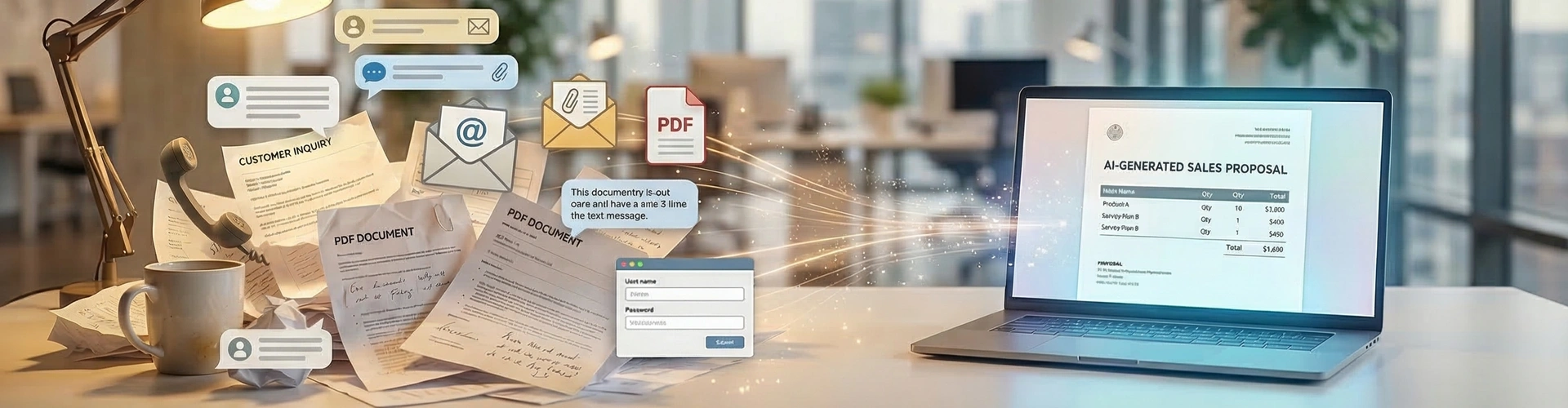
Sales departments in many companies are stuck in a bottleneck that grows more painful with every increase in inquiry volume: proposal creation. Dozens of inquiries arrive daily via email, PDF, chat, phone, or web form. Each one is structured differently — ranging from a brief three-line email to a multi-page requirements document with technical specifications and custom requests.
Today, the entire process is manual: read the inquiry, understand what the customer wants, identify line items, look them up in the catalog, calculate prices, draft the proposal text, format it, send it out. Depending on complexity, a single proposal can take an employee up to 60 minutes or more. With dozens of inquiries per day, the staffing cost for proposal creation alone adds up fast. The team falls behind, inquiries pile up, response times increase — and orders go to faster competitors.
The core challenge, however, is not speed alone — it is the responsibility a proposal carries:
- Prices must never be hallucinated: a proposal is legally binding. If the AI inserts a wrong price, the company is liable.
- Product matching must be reliable: a wrong product in the proposal is reputational damage. Matching against the company's own catalog must be correct in the vast majority of cases.
- The system must know its own uncertainty: "I could not match this item — please review manually" is more valuable than a wrong match with high confidence.
- GDPR compliance: Customer inquiries contain personal data and trade secrets. These must be protected before they are processed by external (US-based) AI models.
- Edge cases are the norm: hardly any inquiry fits the standard template exactly. The system must recognize what can be automated and what requires human judgment.
The Solution
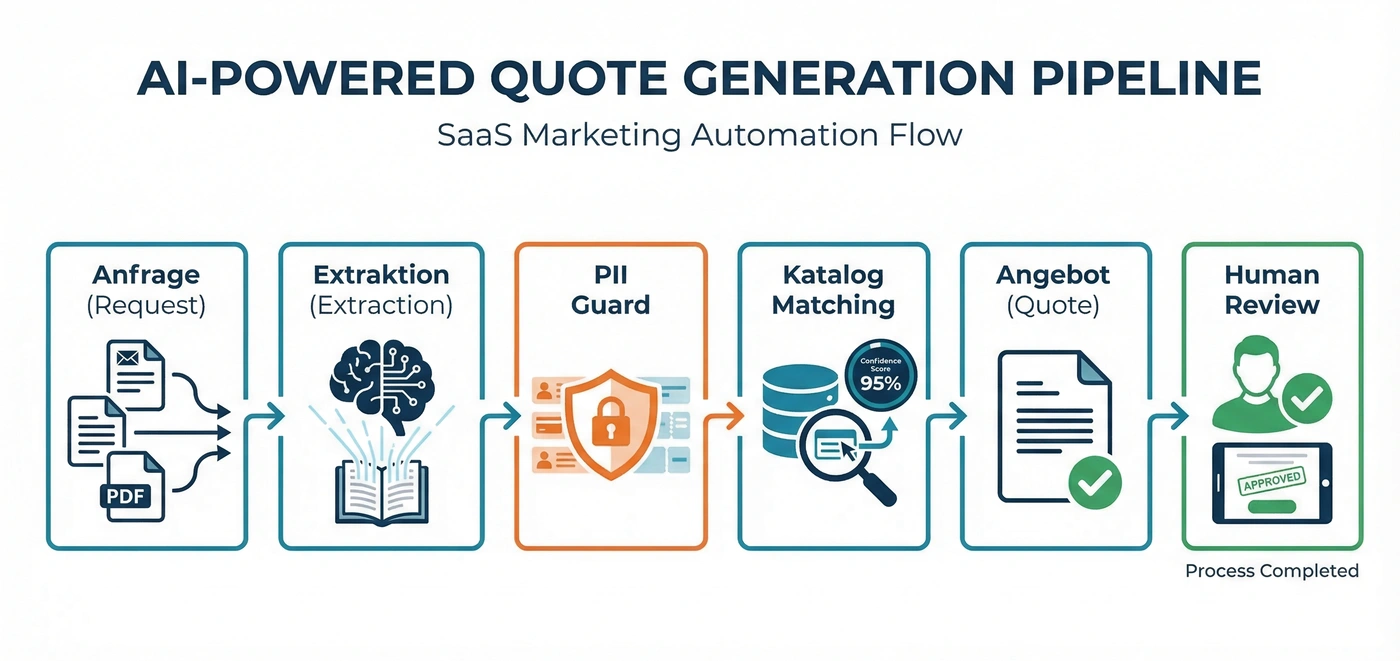
A multi-stage pipeline combining AI-powered and deterministic processing steps, where every stage remains auditable and controllable. The core principle: humans always remain the final authority — AI accelerates and prepares, but never decides alone.
From Inquiry to Structured Data
It starts with a service that accepts inquiries from multiple channels: email forwarding, PDF upload, web form, or — in the future — an AI assistant. An extractor analyzes the inquiry multimodally and breaks it down into structured data: which products or services are requested, quantities, specifications, delivery dates, custom requirements. Before this data is processed further, a PII guard filters out personal data. Customer inquiries often contain sensitive information that must not flow uncontrolled through external AI APIs.
Catalog Matching, Price Calculation, and Validation
A catalog matcher maps the extracted line items to the company's own product catalog. The system accesses company data directly and in read-only mode — prices are never "estimated" by an AI but pulled deterministically from actual catalog data. A confidence score is calculated for every match: the system knows when it is certain and when it is not. Items with low scores are explicitly flagged for manual review by the sales representative.
Proposal Generation with Human in the Loop
A final offer generator assembles an editable proposal from the validated data — complete with precisely matched line items, calculated prices, and a professionally written proposal text. The finished proposal is presented to the sales representative for review. They can adjust, revise with AI assistance, or edit directly before it is formatted and sent. When open questions remain, the system automatically routes the inquiry to a team member instead of guessing an uncertain answer.
Robustness and Scaling
Behind the AI pipeline lie infrastructure challenges we are actively working through: What happens when an LLM API goes down or is overloaded? How do we enforce rate limits? How does the system scale when hundreds of sales reps process inquiries simultaneously? Potential solutions include observer patterns for monitoring, granular metrics tracking across every pipeline step, and fallback strategies for API outages.
Design Principles — Summary
- No hallucinated prices. Ever. Prices come exclusively from the database: deterministic, not generative. The AI matches — it does not invent numbers.
- Confidence over correctness. A system that says "I'm not sure" is more valuable than one that guesses wrong. Every step delivers confidence scores.
- Every step auditable. The pipeline is built so you can trace what the AI did and why at every point.
- Human in the loop is not a workaround — it is an architectural principle. The sales rep reviews and refines. AI takes over the grunt work, not the responsibility.
- GDPR built in from day one. Personal data is filtered before it reaches external APIs.
Related Case Studies
INSIGHT — INtelligent Synthesis and Generation of High-quality Test Data
Realistic test data without real data
Synthetic test data at the push of a button. Rule-based, statistical, AI-powered.
View case study
AKARA Launchpad
Build real prototypes fast — AI-powered rapid prototyping
How an AI-powered platform cuts requirements engineering from a week-long workshop down to 10 minutes — delivering better results than traditional consulting.
View case study
Intelligent Document Management with AI
From manual filing to AI-powered document automation – without expensive licenses
Searching for invoices, tracking deadlines, sorting receipts – this eats up hours every week in many SMEs. This case study shows how open-source software and artificial intelligence can build a complete document management system that automatically recognizes and categorizes documents
View case study