AKARA Launchpad
Build real prototypes fast — AI-powered rapid prototyping
The Challenge
Every software project starts with the same question: What exactly should be built?
Requirements engineering is the systematic process of gathering, documenting, and validating requirements. It is the most critical phase of any software project. Decades of research confirm: the costliest mistakes don't happen during coding — they happen when requirements are incomplete, contradictory, or misunderstood.
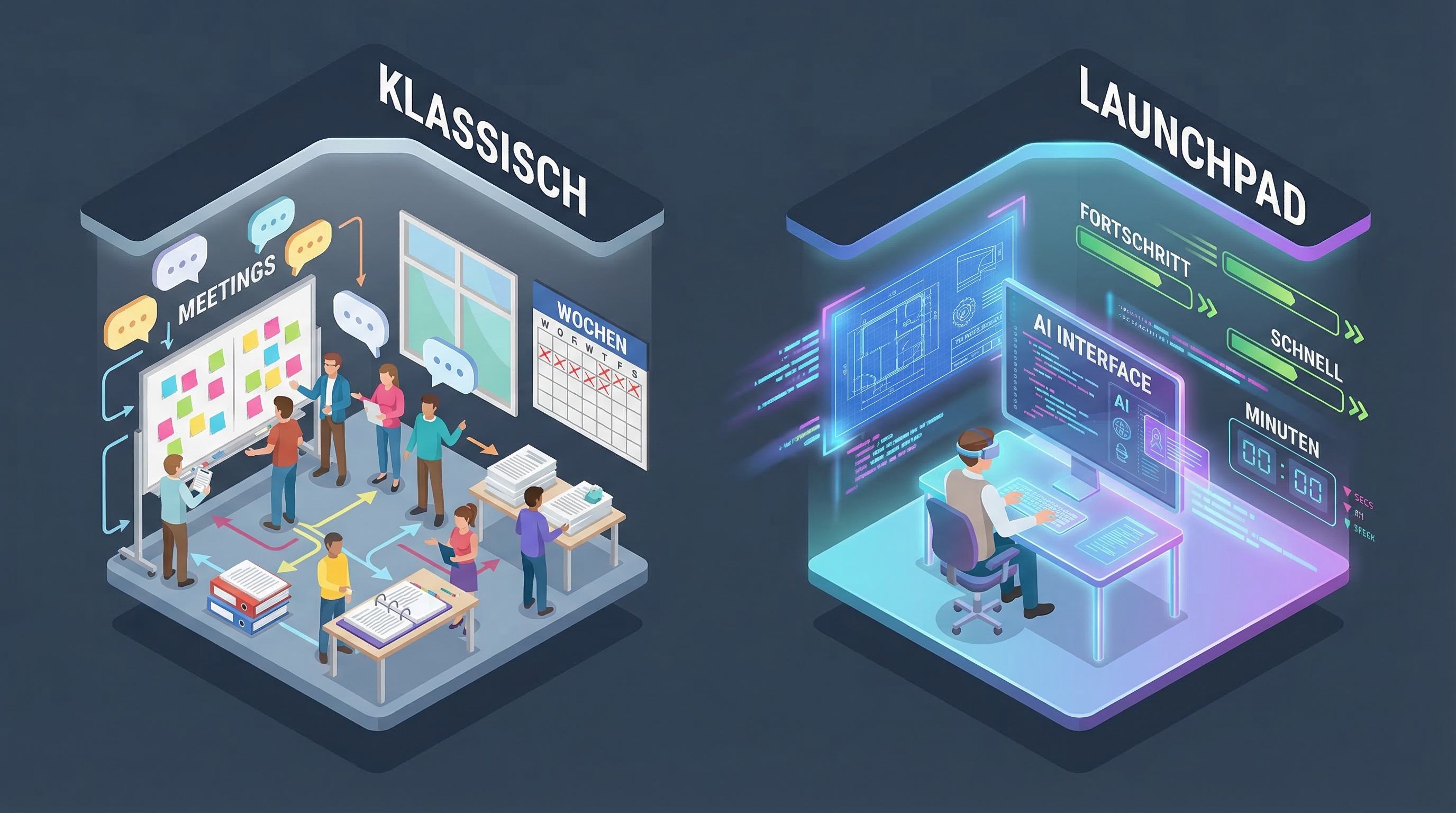
The traditional process looks like this: a week of workshops with stakeholders, whiteboards covered in Post-its, design thinking sessions, meeting notes nobody reads, and at the end a 40-page requirements document that's already outdated by the time it's finished.
What makes this genuinely hard
The problem isn't the effort — it's the uncertainty. Clients often don't know what they want. They can describe problems but can't specify solutions. A stakeholder says: "We need a dashboard" — but means three different things depending on whether you ask the CEO, the sales director, or the developer.
Traditional requirements engineering tries to resolve this uncertainty through conversations. It works, but it takes weeks, costs €10,000 to €50,000 in consulting fees, and the result is a document the client can't touch. No prototype. No clickable interface. Just text.
The alternative — "just start building and see what happens" — is more expensive. Every iteration based on wrong assumptions costs multiples of what a proper specification would have cost.
The service provider's dilemma
For a software agency like AKARA Solutions, this is a business problem. Invest a week in workshops before a single line of code is written, and margins shrink. Skip the requirements analysis, and the risk of building the wrong thing goes up. Neither option scales.
What's missing: a way to confront clients within minutes with a tangible, testable result — not a document, but a working prototype. Not to replace the conversation, but to elevate it: away from "What do you mean by that?" toward "Click here — is this what you need?"
Example: The design phase of the Apollo program
There is a fundamental problem in requirements gathering that persists across projects of every scale: the assumption that a complete, formally correct specification is enough to ensure the right thing gets built. An episode from the Apollo program illustrates why that's wrong — and what works instead.
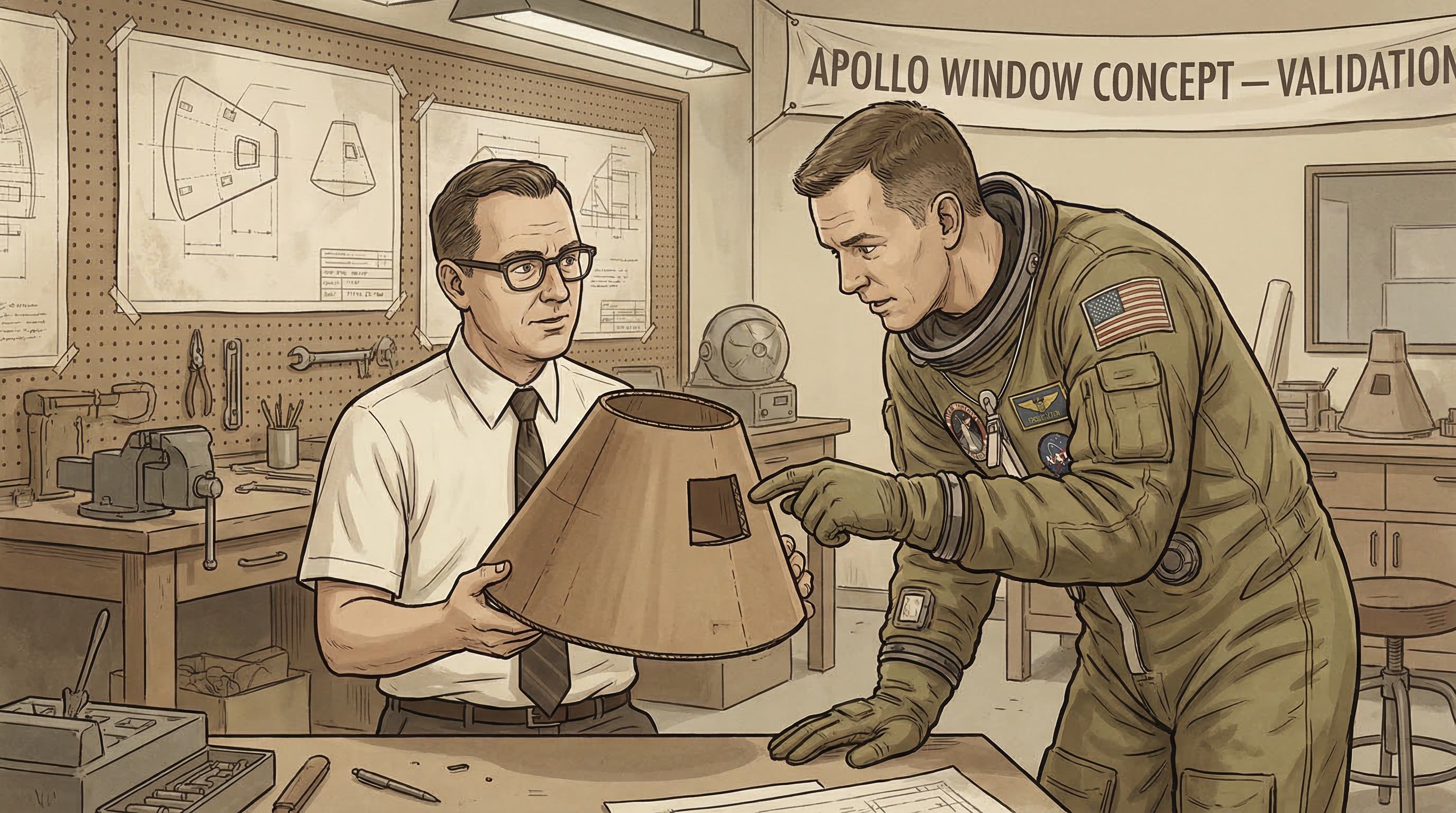
During the design phase of the Apollo capsule, engineers worked on the window specifications. The requirements were in exactly the form you'd expect: dimensions, position coordinates, material thickness, tolerances, thermal stress values. Every line was technically correct, reviewed, and approved.
One engineer decided to validate the specification a different way. He built a simple cardboard mockup of the capsule wall with the window cutout at exactly the specified dimensions and position. Then he asked the astronauts to sit inside.
The result was clear: the field of vision was insufficient. For docking maneuvers, visual attitude control, and navigation, the overview was missing. The astronauts could immediately point out where the problems were — something they couldn't do when reading the specification. Position, size, and angle of the windows had to be fundamentally redesigned.
The Solution
Requirements engineering as an algorithm
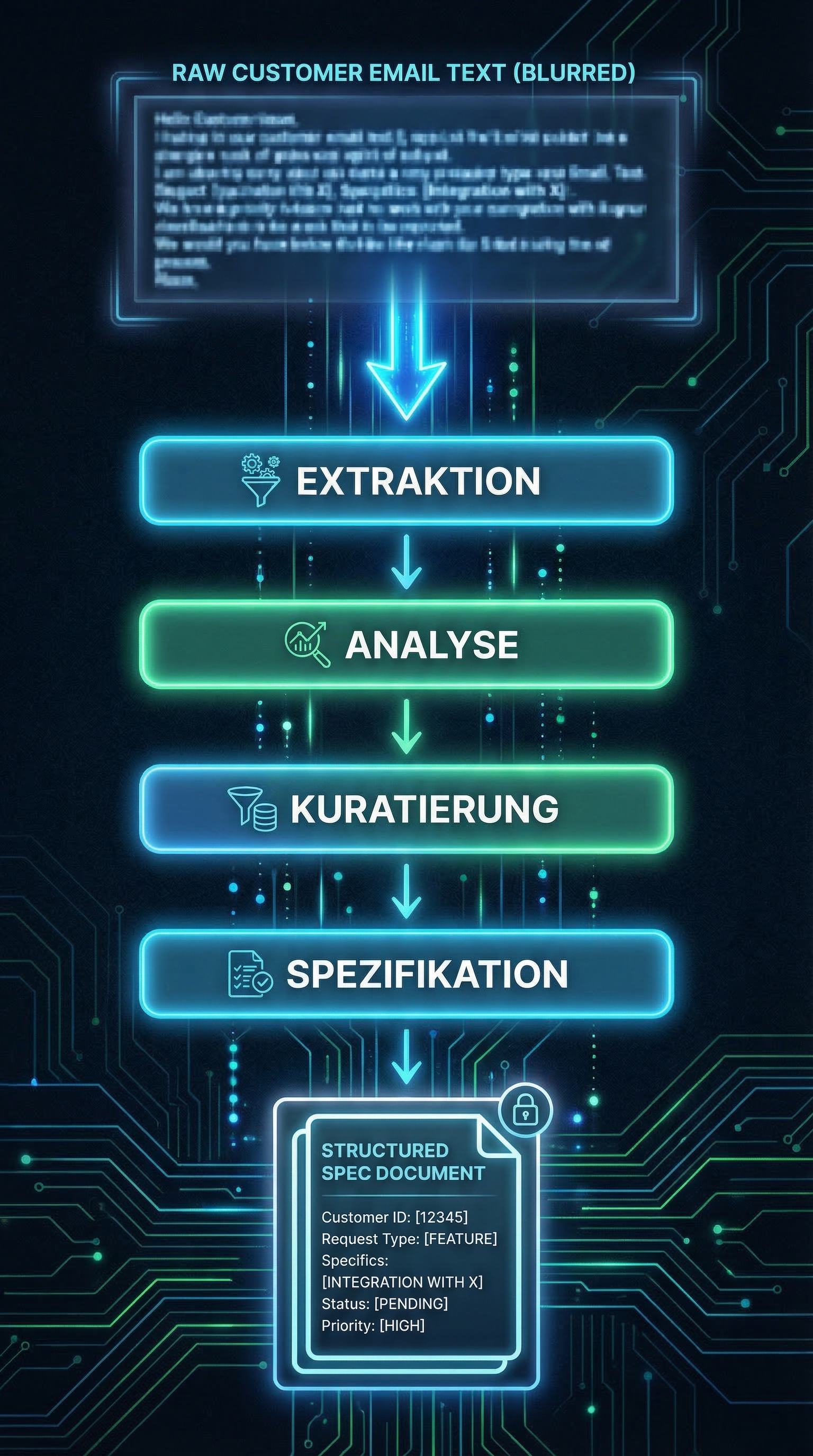
AKARA Launchpad transforms the requirements gathering process into a systematic, AI-powered pipeline to reach shared prototypes with our clients fast. Instead of week-long workshops, the platform generates complete specifications and prototypes in minutes — including market analysis, competitive research, and feature prioritization. We refine these prototypes together with our clients and build the software they actually want to use on this foundation.
The Apollo window example described above doesn't reveal a weakness of a particular engineering team. It reveals a structural limitation of document-driven requirements engineering: specifications describe properties. Requirements describe needs. Between the two lies a translation gap that can't be closed with more precise wording — only through validation against the experienced result.
AKARA Launchpad creates that result.
Design principles
Our clients don't get a document to read — they get a prototype and a result to evaluate. A detailed prototype is ready in 20 minutes. Not to be "done," but to uncover divergences. The conversation shifts from "Describe what you need" to "Click here and tell us what's wrong."
Specs as executable algorithms
The Launchpad uses AI templates to generate prototypes.
Every project type — whether website, mobile app, or browser extension — is developed using templates. These templates are not forms. They are state machines. Feature extraction, prompt injection, validation scoring are built into the flow. Every specification is validated against defined criteria and rated with a quality score before being handed off to developers (or agents).
Market intelligence by default
Every specification automatically includes competitive data. Not because the user asked for it, but because no product exists in a vacuum. The research pipeline ensures that every solution starts with a blue ocean advantage — backed by real market data, not gut feeling.
AI accelerates — it doesn't decide
Humans curate the feature list. Humans review the specification. Humans decide what gets built into our prototypes. AI handles the research, structuring, and writing — removing the overhead that consumes 80% of the time in traditional requirements engineering.
The Results
Traditional requirements gathering typically means a week-long workshop with numerous stakeholders — with the Launchpad, this drops to ten minutes in a guided wizard.
Where the traditional approach yields first testable results after four to eight weeks at the earliest — because the specification must be completed and then implemented — the Launchpad delivers a working prototype in twenty minutes.
The market and competitive analysis — traditionally commissioned separately at a cost of €5,000 to €15,000 — is automatically included in every Launchpad spec. The cost difference for the specification itself is equally stark: traditional consulting runs €10,000 to €50,000. And while the traditional process ends with a PDF requirements document that must be manually interpreted, Launchpad delivers a machine-readable specification with a prioritized feature list that gets turned into a real prototype within minutes.
Quantitative results
Related Case Studies
INSIGHT — INtelligent Synthesis and Generation of High-quality Test Data
Realistic test data without real data
Synthetic test data at the push of a button. Rule-based, statistical, AI-powered.
View case study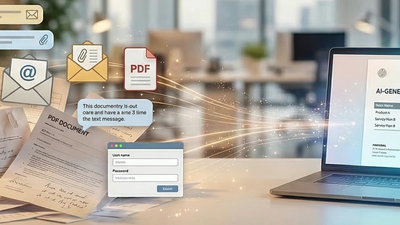
AI-Powered Proposal Generator
An exploratory study on how a multi-stage AI pipeline can shrink the path from customer inquiry to ready-to-send proposal down to seconds — without giving up control
Sales teams spend hours manually turning customer inquiries into proposals: reading, matching, calculating, writing. We show how AI can cut this process down to seconds.
View case study
Intelligent Document Management with AI
From manual filing to AI-powered document automation – without expensive licenses
Searching for invoices, tracking deadlines, sorting receipts – this eats up hours every week in many SMEs. This case study shows how open-source software and artificial intelligence can build a complete document management system that automatically recognizes and categorizes documents
View case study